Private Pilot checkride prep
Take the oral before the oral.
Pilot Oral is an AI practice examiner. It hands you a cross-country to plan, asks what a real examiner asks, follows up when your answer is thin, and then shows you exactly what to study.
- Built on the Private Pilot ACS: all 20 oral tasks
- Answer out loud, hands-free, or type
- About 15 minutes a session, never the same oral twice
Practice only. Not affiliated with the FAA.
Scripted demo · the real app's examiner, running live
Why it works
Flashcards check what you memorized. An examiner checks whether you can use it.
The oral is a conversation about one flight. You get asked why, what if, and show me. That is a different skill from recalling a number, and it only improves by doing it.
Studying alone
- You grade yourself, and you are generous
- Questions come one fact at a time, with no flight behind them
- Nobody asks the follow-up you were hoping to avoid
- You never say the answer out loud until checkride day
A session with Pilot Oral
- Your answer is checked point by point against the ACS
- Every question hangs on a flight you are about to make
- A thin answer gets the follow-up; an unsafe one gets challenged
- You practice saying it, to someone who is listening
How it works
Four steps, about fifteen minutes.
Pick your examiner and airplane
Six examiners with different manners and voices. Fly the Cessna 172M, the Cessna 150G or the Piper Cherokee 140.
Get your flight
A cross-country somewhere in the U.S., with the nav log, sectional chart, weather, NOTAMs, weight and balance, and the airplane's records.
Answer like it's the real thing
Speak or type. Use the documents the way you would at the table. Some things the examiner will expect from memory.
Read your debrief
Every topic marked, your own words quoted back, what was missing, and the regulation or handbook section to study.
Your flight
A whole flight on the table. One thing in it is wrong.
Each oral comes with its own packet, just like the one you will bring to the checkride. Somewhere in it is a problem a careful pilot would catch. The examiner will ask you to show it.
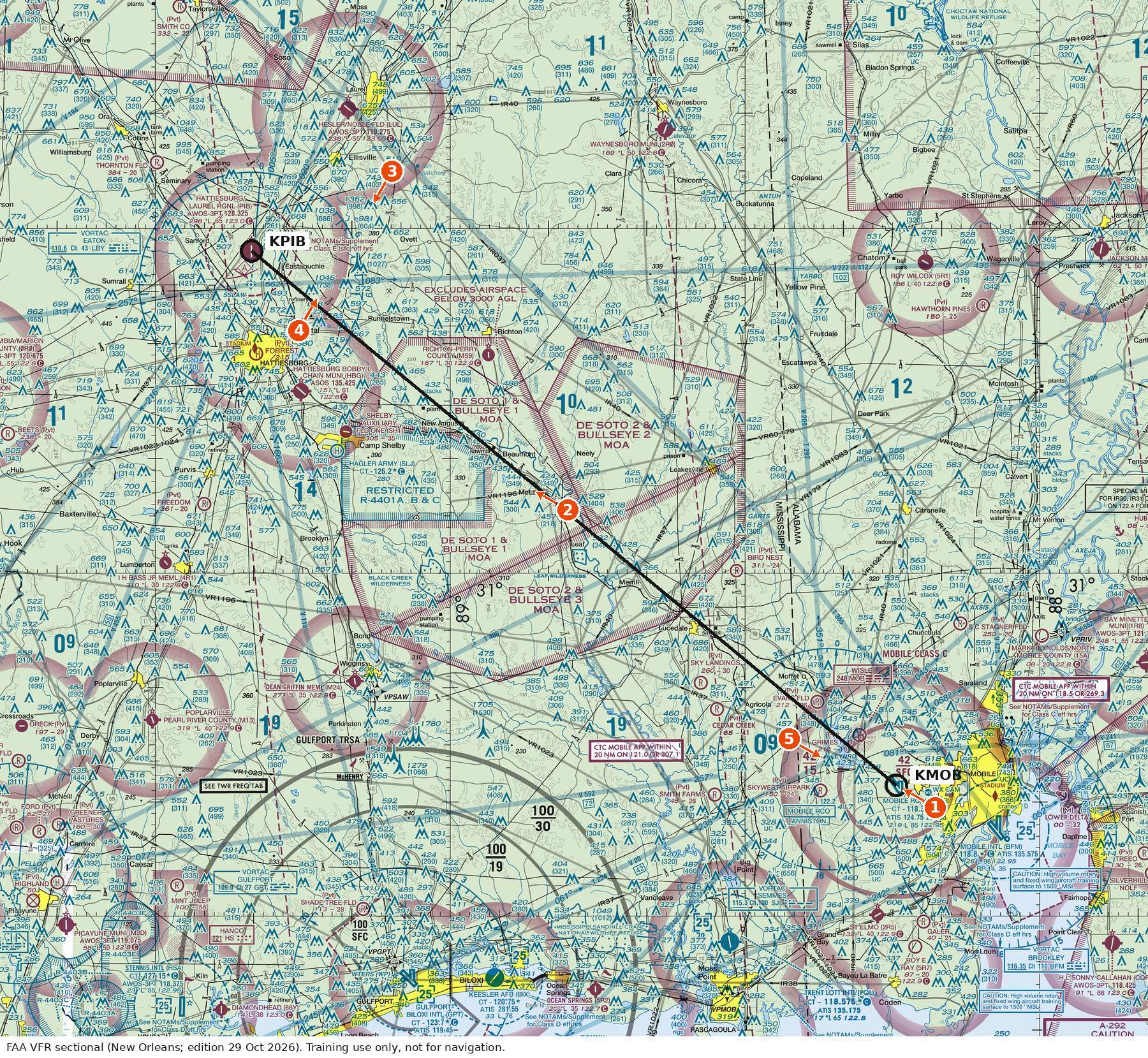
- FAA sectional chart for your route, with questions about what is actually on it
- Maintenance records with inspections to check against the regulations
- Weight and balance worksheet and the POH loading envelope
- Weather and NOTAMs that feed a real go or no-go decision
- FAR lookup built in, because knowing where to look is part of the test
This is the packet for one of the 50 flights. Tap through it. Weather, records and NOTAMs are simulated for training.
Simulated for training
Simulated maintenance records for this practice oral. Today is 17 Nov 2026. The airplane is a flight-school rental also used for flight instruction for hire.
| Item | Record |
|---|---|
| Annual inspection | Completed 14 Oct 2025 (A&P/IA) |
| 100-hour inspection | Last at 5,025.9 tach; tach today 5,052.9 |
| Transponder (91.413) | Tested and inspected Mar 2025 |
| Altimeter/static system (91.411) | Tested Aug 2023 |
| ELT inspection (91.207) | Inspected 09 Jun 2026 |
| ELT battery | Replace by 03/2029 (marked on the unit) |
Did you catch it? The annual was good through the end of October 2026. On 17 November this airplane is not airworthy. In the app nothing is highlighted: finding it is your job.
Practice scenario
| Item | Value |
|---|---|
| Flight | KPIB to KMOB, day VFR, 73 NM |
| Departure | Hattiesburg-Laurel Regional, Moselle, MS (non-towered, elev 298 ft) |
| Destination | Mobile Regional, Mobile, AL (towered, Class C, elev 219 ft) |
| Planned cruise | 3,500 ft |
| Aircraft | Cessna 172M Skyhawk (1976) |
Practice scenario. Airport and route facts are for training only; use current charts and publications for real flights.
| Item | Value |
|---|---|
| True course | 129° |
| Planned TAS | 109 kt |
| Planned departure | 1630Z (1030 local, CST, UTC−6) |
| ETE (no wind) | 0:40 |
| Fuel en route | 4.7 gal at 7 gph |
| Usable fuel | 38 gal |
Simulated for training
Both airports VFR at 1600Z. Mobile TAF from 1900Z: 170 at 12 gusting 20, 5 SM light rain showers, broken 2,500; improving 0200Z.
| Item | Value |
|---|---|
| KMOB TAF | FM1900 17012G20KT 5SM -SHRA BKN025 |
The examiner's question is not "read me the TAF". It is "you're delayed two hours on the ramp. Still going?"
| Item | Value |
|---|---|
| Aircraft | Cessna 172M Skyhawk (1976) |
| Engine | Avco Lycoming O-320-E2D, 150 hp at 2,700 rpm |
| Fuel | 42 gal total, 38 gal usable |
| Maximum weight | 2,300 lb |
| Never exceed, VNE | 160 KIAS |
| Takeoff, max weight, sea level | Ground roll 865 ft; 1,525 ft over a 50-ft obstacle |
| Landing | Ground roll 520 ft; 1,250 ft over a 50-ft obstacle |
| Load factors, normal category | +3.8 / −1.52 flaps up; +3.0 flaps down |
From the 1976 Cessna 172M Skyhawk Pilot's Operating Handbook. Use your own airplane's POH and weight-and-balance records.
Simulated for training
| Location | NOTAM |
|---|---|
| KPIB | Obstruction tower light out of service, 4 NM north of the airport |
| KMOB | Taxiway B closed between taxiways A3 and A5 |
The parts of the regulations a Private Pilot applicant needs, searchable, with the full section text: 14 CFR Parts 1, 43, 61 and 91, and 49 CFR Part 830.
The examiner
It listens to what you actually said.
A list of keywords will not get you through. The examiner checks your answer against the specific points the ACS expects, in your own words, and then does what a good examiner does next.
- Follows up when you leave something out, instead of marking you wrong
- Challenges a statement that would be unsafe in the airplane
- Gives a hint when you say you don't know, then lets you try again
- Holds the standard. In internal testing on our reference oral, 21 of 21 attempts to argue or flatter it into a pass failed
The follow-up Incomplete, then satisfactory
You want to take two friends flying this Saturday. What recent flight experience do you need to carry them?
Three takeoffs and landings in the last 90 days.
In what kind of aircraft? And what changes if you bring them home after dark?
The challenge Safety point
How much fuel do you need to have on board for this trip?
Enough to get to Mobile plus a 30-minute reserve, day or night.
You said 30 minutes applies at night as well. Take another look at that.
Example exchanges. Your questions and follow-ups depend on your flight and your answers.
The debrief
Know exactly what to study tonight.
No score to feel good or bad about. You get each topic marked, the words you used, what the examiner was still waiting to hear, and where to read about it.
- Your own answers quoted, so you can see how they sounded
- References on every topic: 14 CFR, the PHAK, the AIM, your POH
- Safety points called out separately from knowledge gaps
- Saved and shareable. Send it to your CFI before your next lesson
"Enough to get to Mobile plus a 30-minute reserve, day or night."
The night reserve is longer than the day reserve. You corrected the number when asked, but could not say where the rule is.
Study: 14 CFR 91.151 · ACS PA.I.D
"Three takeoffs and landings in the last 90 days."
Right as far as it went. Category and class, and the night full-stop requirement, came only after the follow-up.
Study: 14 CFR 61.57(a) and (b) · ACS PA.I.A
You found the expired annual in the records without being prompted and said the airplane could not fly.
14 CFR 91.409 · ACS PA.I.B
Out loud, with six examiners
Say it before it counts.
Knowing an answer and saying it clearly to an examiner are two different things. Pilot Oral lets you practice the second one, anywhere you can talk.
- Hands-free mode. It listens, hears when you have finished, and replies
- Or type, on the couch or at the FBO, with no microphone needed
- Sounds like aviation. Airport identifiers, frequencies and "niner" are spoken the way pilots say them
- Works in your browser on a phone, tablet or computer. iPhone app planned
These are the app's six examiners, running live on this page. All are fictional AI practice examiners, not FAA designees.
What's covered
Every oral task in the Private Pilot ACS.
The Airman Certification Standards are what your examiner works from. So does Pilot Oral: 400 questions mapped to the 20 tasks an oral can cover, each written four different ways.
PA.I.APilot qualifications14PA.I.BAirworthiness requirements24PA.I.CWeather information48PA.I.DCross-country flight planning30PA.I.ENational airspace system22PA.I.FPerformance and limitations18PA.I.GOperation of systems26PA.I.HHuman factors27PA.II.APreflight assessment16PA.II.BFlight deck management10PA.III.ACommunications, light signals and runway lighting20PA.III.BTraffic patterns12PA.VI.APilotage and dead reckoning22PA.VI.BNavigation systems and radar services14PA.VI.CDiversion10PA.VI.DLost procedures9PA.VII.DSpin awareness12PA.IX.CSystems and equipment malfunctions24PA.IX.DEmergency equipment and survival gear14PA.XI.ANight operations28Numbers are questions per task. Each session draws seven tasks in ACS order, steering away from the ones you practiced most recently, then adds a chart question and a records question.
Never the same oral twice
Fifty flights. Three airplanes. A different oral every time.
Who's behind it
Built by an airline pilot and gold seal flight instructor, and tested like an airplane.
Before any student saw it, Pilot Oral was put through thousands of scripted answers from seven kinds of applicant, from strong and well prepared to rambling, confidently wrong and openly hostile.
Same answer, same grade
In internal testing on our reference oral, identical answers were graded identically 219 times out of 227. You are measured against the standard, not the examiner's mood.
Can't be talked into a pass
In internal testing on our reference oral, every attempt to argue, flatter or instruct the examiner into passing a wrong answer failed. If the debrief says satisfactory, you earned it.
Answer keys in your browser
The expected answers stay on our servers until your debrief is complete. There is nothing to peek at, so the practice stays honest.
What Pilot Oral is not
We would rather you know now.
- It is not approved by, endorsed by or affiliated with the FAA.
- The examiner is an AI practice examiner, not a Designated Pilot Examiner, and a good session is not a guarantee of passing.
- It does not replace your flight instructor, the ACS or your airplane's own POH. Bring your debrief to your CFI.
- Weather, NOTAMs and maintenance records are simulated. Charts are for training, not navigation.
Where it's going
One place to prepare, from Private to CFI.
The Private Pilot oral is ready today. The next certificates are being built the same way.
Private Pilot
Airplane single-engine land. All 20 oral tasks.
Instrument Rating
IFR scenarios, charts and documents.
Commercial Pilot
The step up in privileges and limitations.
Flight Instructor
Including the teaching portion of the oral.
Pricing
Simple pricing. Everything included.
Both plans include everything shown on this page.
Monthly
$— per month
- All 400 questions, 50 flights and 3 airplanes
- All six examiners, voice or text
- A full debrief after every session, saved
- FAR lookup and every practice document
Annual For the long haul
$— per year
- Everything in Monthly
- One payment covers your whole year of training
- New certificates as they are released
Questions
Everything people ask before they start.
Is this approved by the FAA?
No. Pilot Oral is a practice tool and is not approved by, endorsed by or affiliated with the FAA. The examiner is an AI practice examiner, not a Designated Pilot Examiner. It is built from the same public standard your examiner uses, the Private Pilot Airplane ACS.
Which checkride does it prepare me for?
The oral portion of the Private Pilot practical test, airplane single-engine land. Instrument, Commercial and Flight Instructor orals are planned.
How long does a session take?
About 15 minutes. A session is nine questions: seven ACS tasks, one question about your sectional chart, and one about the airplane's records. Follow-ups can add a few more exchanges.
How does it decide whether my answer was right?
Each question has specific points drawn from the ACS and its references. The examiner checks whether you covered them in your own words, so you do not need magic phrases. If you leave something out you get a follow-up, the way you would in a real oral. If you say something unsafe, it asks you to reconsider.
Will I get the same questions every time?
No. There are 400 questions, each written four ways, across 50 different flights and three airplanes. Sessions steer away from tasks you practiced recently, and each flight has its own chart, weather, loading and a different problem hidden in the paperwork.
Can I look things up during the oral?
Yes, like the real thing. Your flight's documents and a searchable set of the regulations are one tap away. The examiner will tell you when something is expected from memory.
Do I have to talk? I don't have a good microphone.
No. You can type every answer. If you do want to practice out loud, hands-free mode uses your device's microphone, listens until you stop, and the examiner speaks back.
What do I need to run it?
A current web browser on a phone, tablet or computer, and an internet connection. There is nothing to install. An iPhone app is planned.
I'm not training in a 172, a 150 or a Cherokee. Is it still useful?
Yes. Regulations, weather, airspace, human factors and decision-making are the same in any trainer, and they are most of the oral. Airplane numbers in the app come from those three handbooks, so learn your own airplane's limitations from its POH.
Does this replace a mock oral with my instructor?
No, it makes that hour worth more. Use Pilot Oral between lessons to find your weak areas, then send the debrief to your CFI so your time together goes to what you actually need.
How do I know the debrief is correct?
Every topic in the debrief cites its source: the regulation, the handbook chapter or the AIM section. Read the reference. If you think a grade is wrong, tell us and we will review it.
What happens to my answers?
Your answers are sent to our AI provider to be transcribed and graded, and your debriefs are saved to your account so you can review them. We do not sell your information or use it for advertising. The privacy policy has the details.
My checkride is next week. Is it too late?
No. A session takes about 15 minutes, and the debrief tells you which tasks to spend your remaining evenings on. Several short sessions will show you more than one long cram.
Who built it?
An airline pilot and gold seal flight instructor (CFI and CFII) who wanted his own students to walk into the oral having already been asked the hard follow-up questions.
Your examiner is going to ask. Answer here first.
About fifteen minutes tonight will tell you more about your readiness than another pass through the flashcards.
Start practicingPractice only. Not affiliated with the FAA.